To Catch a Loon

Captured Loon.jpg

In late May Audubon member Jim Morris reported that a Common Loon had appeared on a tiny stormwater retention pond located between capturing a loonShaw's supermarket and Friendly's restaurant at Tafts Corner in Williston. For the next few months this loon attracted the attention of hundreds of observers, including representatives of the Vermont Fish and Wildlife Department. The hope was that the bird would be able to leave the pond on its own; but no, it seemed to be perfectly content to stay put, subsisting on the healthy goldfish population swimming in the pond. Unfortunately, this loon was stuck.

Enter Eric Hanson, the Vermont Center for Ecostudies expert on Vermont's loons and the leader of the Loon Recovery Project in Vermont. On a warm July evening Eric, his summer intern Shannon Maes, and five volunteers (Jim Wallace, Carl Runge, Jim Morris (Yes, that Jim Morris), Maeve Kim, and Bruce MacPherson) gathered to plot the capture and release of this imprisoned creature. This proved to be no easy task. The loon was skittish, diving at every opportunity, and not necessarily a willing participant in this caper. But Eric had a plan-in fact, two plans. Plan A involved launching a 12 foot aluminum boat on this little pond, powered by a small electric motor. Using a one million candlepower spotlight to "freeze" the bird and a taped loon call to attract her attention, Eric planned to approach the loon carefully and scoop her up in an oversized fish net. Easier said than done. Plan B involved stretching a gill net, provided by VT F&W across the pond, trapping the bird in the folds of the net. Really!

As darkness fell, we gathered the equipment for this improbable adventure at the edge of the pond. After launching the boat, Jim Wallace steered toward the loon, Shannon held the spotlight, and Eric turned on a recording of a yodeling loon, the male territorial call. The rest of us held our collective breath. At first the loon was leery, but in a few minutes she became interested in the intruder's call and allowed the boat to approach her. In a moment-swoosh-it was over. The loon was engulfed in the net and was swiftly transferred to a padded cardboard box for safekeeping.

Onshore, Eric carefully collected basic data about the bird, determining that she was somewhat smaller than most Lake Champlain loons. Shannon held the bird's beak, while Maeve held the rest of the bird securely. Eric surmised that she might be a vagrant headed for Quebec based on her small size. While all this activity was taking place Gail Osherenko filmed the action. Gail's video now appears on her blog at http://www.vermontloonblog.wordpress.com. The rest of us looked on in awe.

In a few minutes this operation was over. The loon was placed securely back in her box for transport to Lake Champlain. Later that night she was released safely and successfully at the Burlington waterfront.

You can learn more about this adventure by visiting the Vermont Center for Ecostudies website at http://www.vtecostudies.org/. Thanks to Carl Runge for providing a photo of the captured loon.

A Bird in the Hand

BirdInHand_240.jpg

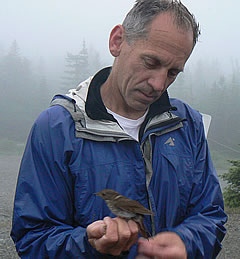
One of Vermont's iconic summer birds is the elusive Bicknell's Thrush. A resident of the spruce-fir forests found on the mountaintops of the northeastern United States and Canada, Bicknell's Thrush is a species of conservation concern as climate change slowly strangles its breeding habitat. On June 22 and 23 members of the GMAS and invited guests journeyed to the top of Mount Mansfield to meet one of the world's experts on Bicknell's ThrushBird in the hand, Chris Rimmer, founder and Director of the Vermont Center for Ecostudies. For nearly 20 years Chris and his coworkers have studied Bicknell's Thrush on its breeding ground at the top of Mount Mansfield and other Vermont mountains and on its wintering range in Hispaniola. No one is better equipped to educate us about Bicknell's Thrush than Chris Rimmer.

Even in late June the weather at the top of Mount Mansfield is unpredictable and often forbidding. Perhaps, then, it should not have been surprising to encounter dense fog, driving rain, and gusty winds when we arrived at the parking lot at the end of the Toll Road the first evening. No "dusk chorus" for us. Still, Chris was undeterred as he calmly described his research and the history and biology of Bicknell's Thrush in the montane forest. One has to admire this tough liittle bird that survives, indeed thrives, under such adverse weather conditions.

The next morning was better-a literal window of opportunity as the harsh weather temporarily subsided. At 5 A.M. we gathered in the parking lot again to learn more about Bicknell's Thrush. Chris reached into his magic bird bag and retrieved a first year, banded thrush that he had captured in a mist net earlier that morning. Patiently, Chris pointed out that these tiny thrushes travel thousands of miles in migration between Vermont and Hispaniola. One 11 year old bird that he captured on several occasions had traveled an estimated 49,000 miles in his lifetime. Incredible. After recording basic anatomical measurements from this bird (weight, length, wing length, etc.) and allowing a few minutes for photographs, Chris handed the thrush to Jo Wright. After a moment to gain his (and her) composure, the thrush zipped off into the tangle of spruce and fir trees nearby.

A few minutes later Chris released another captive bird from a mist net, a handsome, male Blackpoll Warbler. Chris went through his data gathering routine again, then handed the bird to Jo's husband Chip. The warbler seemed to be quite content resting in Chip's open palm for a few minutes, but finally was induced to return to the forest.

It was a privilege to experience the unique montane habitat at the top of Mount Mansfield, even, or perhaps especially in such inclement weather. Bicknell''s Thrush, Blackpoll Warbler, White-throated Sparrow, Dark-eyed Junco, Swainson's Thrush, and Winter Wren live and breed in these mountains. We were fortunate to spend a few hours walking the narrow trails and inspecting the mist nets to learn more about these special birds and the efforts of investigators like Chris Rimmer to conserve them.

Thanks to Shirley Zundell for her photo of Chris Rimmer holding a Bicknell's Thrush.

The Plight of the Bobolink

by Bruce MacPherson

Robert of Lincoln

Merrily swinging on brier and weed,
Near to the nest of his little dame,
Over the mountain-side or mead,
Robert of Lincoln is telling his name:
Bob-o’-link, bob-o’-link,
Spink, spank, spink;
Snug and safe is that nest of ours,
Hidden among the summer flowers.
Chee, chee, chee.

Robert of Lincoln is gaily drest,
Wearing a bright black wedding coat;
White are his shoulders and white his crest.
Hear him call in his merry note:
Bob-o’-link, bob-o’-link,
Spink, spank, spink;
Look, what a nice new coat is mine,
Sure there was never a bird so fine.
Chee, chee, chee.

                     - William Cullen Bryant

bobolink-lg.jpg

Is there any other bird so celebrated in poetry as the Bobolink? Bryant, Emily Dickinson, and many others have portrayed the wonder of Bobolinks in their poetry. Bobolinks are celebrated in music, too. In fact, an a capella singing group at Middlebury College calls itself the Bobolinks. Would anyone willingly listen to a singing group that called themselves the Middlebury Grackles. Of course not.

Bryant’s poem (and there is much more) describes Bobolinks perfectly. Bobolinks are the only North American bird that is white on the back and black underneath like a “tuxedo worn backwards”. That creamy, yellowish-white nape is unmistakable, as Bryant points out. Of course, this distinctive plumage applies only to breeding males. Females and non-breeding males are drab and buffy with stripes on the face, back, and rump, blending perfectly into their grassy habitat. Unusual among songbirds, Bobolinks undergo two complete molts each year-one molt on the breeding grounds and another on their wintering grounds. After this second molt, the males are rather drab, but the yellowish tint to their feathers rapidly wears off to reveal the stunning breeding plumage for which they are best known.

And how about that ebullient song. In spring and early summer, the Bobolink’s song rings out through the countryside. Described as “a bubbly delirium of ecstatic music” or sometimes as an imitation of the loveable Star Wars robot R2D2, song alone marks the Bobolink as a bird of distinction. In the Northeast the song of the Bobolink is as characteristic of summer as the tinkle of the bell announcing the arrival of the ice cream truck.

During breeding season Bobolinks are widespread in North America, ranging from the prairies of the Midwest to the hayfields and pastures of the northeastern United States and southern Canada. Here they build their nests on the ground, fledge their young, and molt their feathers. After a visit that seems too short, Bobolinks depart in late summer and early fall for their wintering grounds in the grasslands of Argentina, Paraguay, and Bolivia with only a stop or two along the way.

Although Bobolinks are still fairly common birds, the population has steadily declined for many years. Habitat for Bobolinks was optimal when the United States was predominantly rural and the land was cleared for farming. As agriculture declined and hayfields and meadows reverted to forest, breeding habitat for Bobolinks was lost. Furthermore, intensive hay cutting during the breeding season destroys many Bobolink nests and fledglings each year. Preservation of open grasslands and providing incentives for farmers to delay hay cutting until after the breeding season is over would help to stabilize the population of these iconic birds of summer.

All is not well for Bobolinks wintering in the southern hemisphere either. Huge flocks of Bobolinks forage in the rice fields of South and Central America (the Latin name for Bobolinks, Dolichonyx oryzivorous, means “long-clawed rice-eater”), where they are harassed by angry farmers.  Likewise, the unregulated use of pesticides in the southern hemisphere poses an additional threat to the dwindling Bobolink population.

What to do? The first step in developing a conservation plan is to learn more about the relative threats to Bobolink populations throughout their range. In this regard an investigator from the Vermont Center for Ecostudies, Dr. Rosalind Renfrew, has done seminal work, revealing the secrets of Bobolink behavior throughout their annual cycle. Dr. Renfrew’s thoughts on the plight of the Bobolink are recounted in the interview with her that follows this article.

An Interview with Dr. Rosalind Renfrew

bobolink_200.jpg

You have been studying Bobolinks for some time now. What sparked your interest in Bobolinks in the first place?

Bobolinks may be charismatic, with their bubbly song and striking colors, but what really drew my attention was their incredible migration, and the fact that we knew next to nothing about their life on the other side of it. 

The results of the 2nd New York Breeding Bird Atlas were published recently and documented a modest 8% decrease in blocks with nesting Bobolinks compared with the previous survey in 1980-85. What can you tell us about Bobolink population trends in Vermont and across the country? Are Bobolinks a Species of Special Concern in Vermont?

Yes. In Vermont the distribution of Bobolinks has not changed appreciably in the last 25 years, but where they do occur, abundance has been declining. They occupied 6 percent fewer blocks in the second Vermont Breeding Bird Atlas compared to the first Atlas. What is of more concern, however, is that the Breeding Bird Survey shows an annual decline of 2.9% for Vermont from 1982 to 2007. Vermont is part of a larger-scale trend: Bobolink populations have been decreasing by 1.8% per year range-wide since 1970, and declines have been most severe during the last 10 years. Canada has lost 88% of its Bobolink population since 1970. Because declines have continued unabated during the last 10 years and threats to populations persist, Canada added the species to its Threatened list in 2010.

Bobolinks, of course, are champion migrators. You have obtained some fascinating results concerning Bobolink migration using geolocator technology. What did you discover? What surprised you most about Bobolink migration?

Geolocators represent an innovative new technology for analyzing bird migration patterns. Small light-sensitive chips attached to captured birds record and store data based on the time of sunrise and sunset that can be evaluated with software when the birds are recaptured. The data we obtained from only three Bobolinks (2 from VT, 1 from NH) shed dramatic new light into the location and timing of migration stopovers, routes, and wintering grounds. Two birds that were breeding 7 km apart in the Champlain Valley did not winter together, nor did they share the same migration route. Each of the three birds had 2-4 stopovers per migration, and some fall stopovers lasted for weeks. The Bahamas are a short but potentially important stopover during spring migration, and Colombia and Venezuela appear to be important stopovers in the spring and fall, respectively. Although Bobolinks do move around to some extent during winter, they do remain in the same general area for 2.5-3.5 months. All three birds left their wintering areas during the first week of April to migrate north (it was previously thought that they departed in early March). These are just some of the highlights.

The biggest surprise was a transoceanic flight by one bird of 1900 km (1100 mi) within 24 hours - which means the bird flew an average of 50 mph for 24 hours. I checked and rechecked my data, and consulted with the developers of the geolocator software, and it is a certainty that the bird made this trek as part of its migration north. Undoubtedly, it had the help of a tailwind, and the weather data from the area on that day support this assumption. Even so, I never thought this species to be capable of migration speeds similar to those of shorebirds.

My colleagues and I hope to retrieve more geolocators this year that will provide insights about the migration patterns, timing, and wintering areas of populations across the breeding range.

A few years ago you discovered a huge, previously unknown flock of Bobolinks feasting in the rice fields of Bolivia and speculated that there might be more. What is the significance of this finding? Are there more mega-flocks of Bobolinks in South America yet to be discovered?

This was the first time that such enormous flocks were documented, although it was nothing new to the local farmers. After this discovery, biologists in Argentina searched in rice fields and also found large Bobolink flocks. All observations on the wintering grounds, however, collectively account for less than 5% of the entire Bobolink population; there are clearly other areas supporting wintering Bobolinks that have not been discovered. I suspect that Bobolinks also overwinter in the wetlands of the Pantanal (southern Brazil), but this area has so far only been described as a migratory stopover.

It’s hard to believe that Bobolinks are regarded as pests in South and Central America, whereas they are revered in the United States and Canada as an iconic summer bird. You have surveyed farmer’s attitudes toward Bobolinks in the southern hemisphere. What did you find? What can be done to change these attitudes?

First and foremost, it is critical to recognize that there is actually little difference in attitudes between farmers in North and South America- just different pests. A rice producer in Bolivia is no different from a sunflower producer in the U.S. struggling to keep Red-winged Blackbirds at bay. Although birdwatchers may enjoy the Bobolink, scathing remarks about the species appeared in farmers’ journals in Canada once the species was declared Threatened and had the potential to disrupt haying operations (farmers now have a 3-year exemption while a plan is developed). If you’re watching a species disrupt your operations, or literally eat into your income, probably nobody is going to change your attitude.

Attitudes in Bolivia varied depending on the farmer’s experience with the Bobolink. Newer rice farmers weren’t bothered by the birds, while those who had been fending off the species for decades tended to have zero tolerance. My sense was that estimates of the damage caused by Bobolinks were often exaggerated by the latter group, and this has been seen with other species in other countries. But the threat to farmers is very real and needs to be addressed. Determining just how much (or how little) the birds are eating may help change perceptions, and may help farmers populate a cost-benefit analysis with some real numbers.

The approach to take is not to talk farmers out of their perceptions, but rather to offer information and most importantly, attempt to develop solutions. While Canada works hard to bring back its population of Bobolinks, we need to be thinking about how to avoid exacerbating the problems for rice growers far south of us, whose control efforts may only make recovery here more difficult and expensive. The north hand needs to know what the south hand is doing, and vice versa; a holistic approach is needed.

There are threats to Bobolinks in the northern hemisphere, too, especially the timing of hay cutting that coincides with Bobolink nesting and breeding. When you look at threats to Bobolinks across the board, which ones are most important to focus on from your perspective?

Threats have so far been addressed only on the breeding grounds, and it is critical to continue to promote management practices that maximize nest productivity. Research from the Champlain Valley (carried out by Noah Perlut and Allan Strong at UVM), however, shows that even the best case scenario on hayed lands will slow but not halt declines. A study in Iowa on non-hayed lands found that to obtain self-sustaining populations of Bobolinks, increasing survival during the non-breeding season was essential. In both cases, survival is an important part of addressing population declines. We need to learn whether, how, and where we can take conservation measures to increase survival during migration and winter, while continuing to maintain and even create quality nesting habitat. In essence, a holistic approach that addresses threats throughout the Bobolinks annual cycle will be needed to get (and keep) Bobolinks back on track.

The Catamount Outdoor Family Center: A Birding Update

By Carl Runge

Brown Thrasher

Brown Thrasher

In this article I would like to bring you up to date on our birding activities at the Catamount Outdoor Family Center in Williston.  In my 2009 report I described our efforts to earn for Catamount a designation as an Important Bird Area (IBA). Here is what has happened since then.

Catamount, located on Governor Chittenden Road in NE Williston, is a 500 acre preserve owned by Jim and Lucy McCullough and managed by their daughter and son-in-law, Abby and Eric Bowker.  It operates as a not for profit organization and is a recreational facility offering mountain biking, hiking and running in the summer and fall and cross country skiing and showshoeing in winter.

The property provides a broad array of habitats that attracts a rich diversity of bird life. Northern hardwood, white pine-hardwood and hemlock forests, early successional forests, marshes, ponds, and open grasslands are all found at the Catamount Outdoor Family Center.  Between 1996 and 2008, the McCulloughs, GMAS, the UVM Spatial Analysis Lab, and I working with the Vermont Center for Ecostudies and the Vermont Breeding Bird Atlas survey identified a total of 94 species of birds at Catamount and confirmed breeding  status for 24 species. Subsequently, surveys conducted after the Breeding Bird Atlas surveys concluded added several new species and new breeding birds to this total as described below.

During this past few years the GMAS held several successful field trips at Catamount. Our observations led us to think that Catamount would be an excellent addition to the places designated by Audubon Vermont as IBAs, and to this end we submitted a formal application to them in September 2008.  Unfortunately, Audubon Vermont never acted on this application, since the whole IBA concept apparently is in flux. As a result Bruce MacPherson, the current GMAS president, conceived the idea of establishing Important Bird Education areas in Vermont, an informal designation which would pinpoint certain locales in the state as centers for bird and nature education.  The driving force behind the establishment and operation of these centers would be local groups, in many cases local Audubon chapters.  This concept was approved at the Vermont Audubon Chapter Assembly meeting in April, 2010 and is in the early stages of implementation. At this point the Green Mountain Audubon Society has designated the Catamount Outdoor Family Center as its Important Bird Education site. This concept meshes nicely with the mission statement of Catamount:  “to promote family and community well being through activity and education in a natural environment.”

In 2009,  the GMAS began a systematic survey of the bird population at Catamount.  Several members have surveyed the area on a weekly basis (monthly in winter), and have recorded and tabulated the results. To date we have completed 71 surveys in all four seasons.  We have added to our original list so that the recorded species now totals 126 with breeding confirmation in 43. The immediate goal of this effort is to create a bird checklist for Catamount which will indicate seasonal frequencies for each species and designate breeding confirmations.  This checklist will be completed and available for distribution by May 2011. The checklist will be provided to Catamount to distribute to anyone who wants to watch birds there and a link to the checklist will appear on the GMAS website.

Notable species seen regularly at the COFC include Bobolinks, Brown Thrashers, Black-throated Green and Black-throated Blue Warblers, Savannah Sparrows, and Easten Bluebirds. Additions during the two Breeding bird Atlas survey years include American Bittern, Northern Shrike, Bohemian Waxwing, Philadelphia Vireo, Blue-winged, Wilson’s, Palm and Prairie Warblers, Winter Wren and Lincoln’s Sparrow.  New breeding confirmations include American Kestrel, Black and White, Black-throated Blue and Blackburnian Warblers, Scarlet Tanager, Eastern Wood Pewee, and Red-breasted Nuthatch.

With the survey results and checklist in hand, the next step for GMAS and Catamount will be to plan how best to utilize this property for bird and nature education.  A first step will be to hold the annual GMAS Birdathon at Catamount on Saturday May 18. Any and all additional ideas are welcome.  Please join us and stay tuned!

Note: A link to the COFC bird checklist can be found by selecting the Resources heading at the top of this page and scrolling down to the bottom of the page. Enjoy.

What's New at the GMAS: Winter, 2011

What happened this winter? Plenty! The 2010 Burlington area Christmas Bird Count took place on December 19, 2010 and the results are in. Shirley Johnson organized 48 CBC participants, who scoured the Burlington circle for birds from dawn to dusk. Seventy-five species were identified, exceeding the old record of 73 set in 2005. New high counts were obtained for Greater and Lesser Scaup, Ring-necked Duck, Peregrine Falcon, Rock Pigeon, Hairy Woodpecker, Pileated Woodpecker, and Golden Eagle. Beautiful winter weather contributed to the enthusiasm of the counters as well as the entertaining round-up at the Johnson's home that evening. Thanks to all of the participants.

The GMAS held its first field trip of 2011 along the shores of Lake Champlain on January 8. bohemian waxwingTwenty-three hardy birders counted 25 species of ducks, geese, grebes, raptors, and songbirds at Shelburne Bay, Shelburne Town Beach, and Charlotte Town Beach. Highlights included a flock of Canada Geese that flew overhead led by two Snow Geese, a Bald Eagle at Shelburne Bay harassing the winter ducks, a handsome male Northern Pintail at the Charlotte Town Beach, and a Red-bellied Woodpecker at the Shelburne Town Beach.

NorthernPintail_200.jpg

Here is a photo of the Northern Pintail taken by Scott Sainsbury and used with his permission.

Later in January Sean Beckett, our 2008 Haidee Antram Award recipient, presented an entertaining program focused on Northern Saw-whet Owls. Sean conducted research on Saw-whet Owls as an undergraduate at Vassar, then spent this past summer banding Saw-whet Owls at the Idaho Bird Observatory near Boise.Red Polls Despite their wide range in North America, little is known about the habits and migration patterns of these diminutive owls. Sean's program answered many of our questions about these fascinating, elusive creatures.

Red Poll

Red Poll

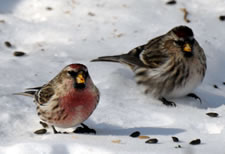
Then in early February naturalist David Govatski presented an informative program describing the behavior of irruptive species, especially Bohemian Waxwings and Common Redpolls, both of which are abundant in Vermont this winter. Predicting irruptions is more art than science, but David shared his vast knowledge of forests and birds with us to help us better understand these irruptions.

Bohemian Waxwing

Bohemian Waxwing

We thank David for his excellent presentation, Larry Clarfeld for a spectacular photo of a Bohemian Waxwing, and Jim Morris for a great photo of irruptive Common Redpolls.

The GMAS has more programs, field trips, and bird monitoring surveys scheduled for March and April. Consult our Calendar of Events for details.

Another Way: Birding by Kayak on Lake Champlain

by Margy Holden

My stereotypical vision of birding used to be an individual or group, strolling slowly, and then stopping, binoculars pointing to a sound or movement, ears cocked to identify, binoculars tilted upward. After kayaking around Lake Champlain, I want to add another version of this passion: the seated floating birder.

MargyBirding_225.jpg

A small, human-powered paddle craft, kayak or canoe, allows access to places that may be denied the walker. Yes, for the birder, there is the same occupational hazard of the neck that gets tired tilted back, but there are distinct advantages. There are no leaves or sticks to crackle underfoot, no soft mud holes to sink into while looking above. At the same time, I have to admit there are disadvantages. Just try to prevent a paddle craft from rocking gently while trying to pin binocular focus on a flitting object. Oh yes, binoculars – even the kind that float don’t always like to be dropped into water, much less the kind that don’t float. Using a spotting scope would be kind of a tough act. Slippery rocks or mucky clay challenge each attempt to enter or get out of the boat. But, even given all this, it’s a great way to go.

The Missisquoi Wildlife Refuge, accessed by Route 78 in West Swanton, is one of my favorite places to paddle and observe birds and other wildlife. It has also been designated an Important Bird Area by the National Audubon Society. While trails abound, taking to the water offers access to places unreachable on foot. Civilization disappears in this watery world. The 6,642-acre refuge provides a rich habitat for nesting and migratory birds as well as other forms of wildlife. The 88-mile Missisquoi River, that drains 1,200 miles of Vermont and Quebec land, has over the centuries since the glaciers, Lake Vermont, and the Champlain Sea receded, created and is still building a delta with three river mouths and numerous side channels. In a few centuries, barring unnatural occurrences, the delta will reach the Canadian border. Charcoal Creek, Dead Creek, which are former channels, and the current main channel of the Missisquoi with its three mouths, all can be easily accessed from marked launch sites. While this is certainly not the place to see some of the species that inhabit upland areas and the Green Mountains, shore birds, ducks, grassland birds, other lower altitude species, and other wildlife abound.

Black Tern

Black Tern

When looking for a beautiful and easy paddle on protected water, I’ll choose Dead Creek. A short paddle up the Missisquoi from Louie’s Landing on Route 78, Dead Creek meanders directly north into reedy Goose Bay. And meander it does. This former channel of the Missisquoi offers little current between banks of overhanging silver maples and occasional willows draped with spider webs. It’s a safe setting for mergansers to raise their young and leopard frogs to perch. Swallows swoop, an occasional kingbird watches, an osprey cruises overhead. The shallow water provides perfect fishing ground for great blues that lift off as we approach, only to circle back as we continue. Watching that bird spread its wings and take flight has to be one of life’s great gifts. Belted kingfishers lead the way, chattering. On one paddle, I concentrated on photographing a blooming reed for later identification while my paddling partner Cathy spotted and successfully took a picture of a much less common, perfectly posing black tern.

Depending on the time of year and the often predictable water level, the paddler looks across surrounding fields and marshes in high water or up at the banks with little visible land behind in low water. Choose your season.  In high water, the sand bar at the Goose Bay mouth of Dead Creek is submerged and of little interest. In low water, the scene changes radically and the sand bar which emerges can be a haven for shore birds as well as egrets, native and migrating gulls, and of course cormorants and Canada geese.

From the Goose Bay end of Dead Creek, turning around and retracing the roughly five miles back to Louie’s Landing, gives an opportunity to savor the river again from the other direction – something I really enjoy. For the very energetic on a day with little wind, another return route heads north, traces the shore of Goose Bay, rounds Martindale Point, follows the shore of Gander Bay to the first mouth of the Missisquoi. The kayaker can then paddle upstream back to the landing, a trip of roughly nine miles, almost half of which is upstream although in low water the current is not strong. The bays of this route are reed-lined and a haven for what the Refuge lists as 20,000 migrating ducks, particularly on the fall days when the wind is from the south. Fall foliage often comes early because the trees along the shore have wet feet. In fact, I challenge you to even determine where the water stops and the shore begins.

In addition to the migratory birds, nesting ducks include wood ducks, green and blue winged teal, common goldeneye, hooded mergansers, and black ducks. The Refuge is the only place in Vermont that the black tern is known to nest. One spring/early summer day many years ago, we left Louie’s Landing and paddled north down the Missisquoi to Shad Island. The water was high enough that we could paddle over a submerged bank of the river into a low land that had become a pond surrounded by trees. We were near the great blue heron rookery that at one time numbered more than 600 nests. What an experience watching them land on a tree limb. The limb bends, wings flap, the limb rocks up and down, until at last: equanimity. The herons ignored us sitting stock still in our canoe. They were not the only nest building, mating species. Fish thumped our canoe, invisible in the murky water, swallows and flycatchers chased each other, and dragonflies attached and detached. It was a regular bacchanalia! We drifted for a couple of hours, enchanted at the re-creation of the life around us.

Late in the afternoon, we paddled back upstream stopping to watch a beaver work. Swimming to the far shore it left the water and selecting a thin branch, quickly gnawed through, dragging it back to into the river and to the far shore. That must have been a special tree. A little further on, we didn’t see the deer at the edge of the water before it saw us and disappeared in a flash of white.  We could hear a wood thrush singing in the distance. What had started out as a simple paddle turned into an incredible experience which I can still picture clearly even years later.

I’ve only scratched the surface. I haven’t even mentioned the turtles. I may – or may not have seen the prehistoric-looking spiny soft-shell turtle. Well, I did see one. But was it real? Back during the Route 78 bridge construction when the state constructed platforms on which the displaced turtles could sun themselves, we had launched kayaks next at the state site adjacent to the bridge. We neared the first platform with great caution and at a distance. Much to our amazement, a spiny soft shell was sunning itself within photographic range. We later learned that some of the platforms had decoys to encourage the real thing to climb aboard. Did we see the real thing? Since then, I’ve seen quite a few, and I do believe. Just paddle out into the refuge on a sunny day and it won’t only be the spiny soft shell variety you can catch catching the rays on every available log and rock.

On the basis of these and other experiences in the Missisquoi Wildlife Refuge, I’d consider designating a new species – or maybe it would be a sub, sub species. How about the Magnificent Northern Sitting Floating Birder? To give this new species a push, I’ll even volunteer that I am one - at least in the Missisquoi Valley Refuge. Oh, and don’t forget to stop at the Refuge headquarters before you leave the area. They have bird lists, reference books and displays, and trail maps in case you want to be one of those traditional standing birders.

Margy Holden is a Board member and former President of the Green Mountain Audubon Society and the coauthor with Cathy Frank of the book A Kayakers Guide to Lake Champlain.

State of the Birds 2010

by Mike Winslow

In early March The State of the Birds: 2010 Report on Climate Change was released.  This 32 page report follows on the heels of the 2009 report that showed nearly a third of the nation's 800 bird species were endangered, threatened or in significant decline. The 2010 report represents a collaboration between the U.S. Fish and Wildlife Service and experts from the nation’s leading conservation organizations including Audubon.

Bird_chart_350.gif

The 2010 report presents the first systematic analysis of what may happen to bird populations in each major biome of the United States as a consequence of climate change.

The report assesses the vulnerability of bird species in eight habitat groupings: oceans, Hawaii, coasts, the Arctic, Pacific islands, grasslands, the Caribbean, arid lands, wetlands, and forests. Forest and wetland species were the most resilient, with 68% and 64% of species respectively categorized as low vulnerability. In contrast Oceanic and Hawaiian species were the most vulnerable.Bird Report Cover

Forest birds are expected to fare better than many other groups because of their large ranges and high reproductive potential. However, even within this group there are some species expected to struggle, for example the Bicknell’s Thrush of Vermont’s mountains.

Ocean birds include albatrosses, petrels, puffins, and murres. These birds face challenges associated with rapid widespread shifts in pelagic food resources as a result of warmer ocean temperatures and changing wind patterns.  They also have a low reproductive rate making these species less resilient in general.

birdsCover_225.jpg

In the conclusions the report worries that, “Without additional information on how birds are responding to the effects of climate change, we will be unable to adjust our conservation and management strategies. Well-designed monitoring systems will also be needed to evaluate the effectiveness of the strategies used to counteract effects of climate change on bird populations.” Audubon chapters can do their part by monitoring bird populations in Vermont.

The report is available on the web at http://www.stateofthebirds.org/

This article is reprinted from the May, 2010 issue of Otter Tracks, the newsletter of the Otter Creek Audubon Society.

Mike Winslow is the staff scientist for the Lake Champlain Committee, a board member of the Otter Creek Audubon Society, and the author of the book Lake Champlain: A Natural History.v