
Birding Under Sail: Discovering the Birds of Lake Champlain
By David Hewitt
How sailing changed the way I see the birds of Lake Champlain
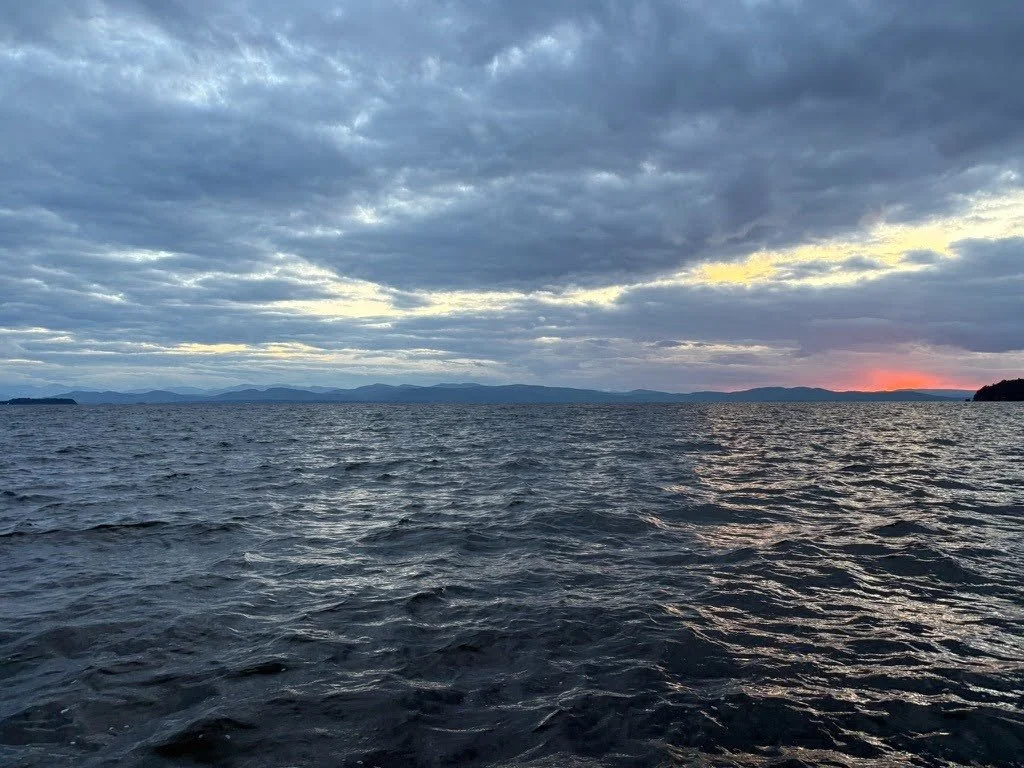
There is something special about being out on Lake Champlain under sail. With Burlington’s waterfront behind you, the Green Mountains rising to the east, and the wind filling your sails, the world seems to slow down. The sounds of the city fade, the water stretches out in every direction, and your attention shifts to the wind, the waves, and the wildlife that shares the lake with you.
During my time as Program Manager at the Lake Champlain Community Sailing Center, I spent many hours on the water aboard a Sonar, a 23-foot keelboat. I am a lifelong sailor and racer from Fairfield, CT and originally chose sailing for the challenge, the camaraderie, and the simple enjoyment of being outdoors. But the more time I spent on the lake, the more I began to appreciate another part of the experience: the birds.
Sailing offers a perspective that is difficult to find from shore. Rather than watching the lake from a beach or a waterfront path, you become part of the landscape. You move quietly across the water, often close enough to observe birds fishing, resting, diving, and flying overhead. Some days, the most memorable moments have nothing to do with sailing at all.
The Cormorant: A Diver Built for the Water
One of the birds that quickly becomes familiar on Lake Champlain is the Double-crested Cormorant. With its dark plumage, long neck, and hooked bill, it is a regular presence around Burlington’s waterfront. You might see one swimming low in the water, its body nearly submerged, before it suddenly disappears beneath the surface in pursuit of a fish.
Cormorants are remarkably skilled underwater hunters. They propel themselves through the water with powerful webbed feet, chasing fish below the surface. Unlike many waterbirds, their feathers are less waterproof, allowing them to become wetter and potentially helping them dive more effectively. This is why you will often see a cormorant perched on a channel marker, rock, or dock with its wings spread wide. It is drying out after a fishing trip. That familiar pose is one of my favorite sights on the lake.
Cormorants also have an interesting history on Lake Champlain. Although they are now a familiar summer sight, their breeding population expanded significantly during the late twentieth century. Their nesting colonies, particularly on islands in the lake, have also created conservation challenges because the birds compete with other native waterbirds for nesting habitat. Their story is a reminder that even common species are part of a complex ecosystem, where the needs of one bird can intersect with those of many others.
The Art of Flight
Sailing has also changed how I think about bird flight. When you spend time aboard a keelboat, you learn quickly that the wind is not simply something that pushes you forward. It is something to read, anticipate, and work with.
A sailor watches the surface of the lake for ripples that signal a shift in the breeze. We adjust the sails, change course, and try to find the most efficient path through the water. Birds face their own challenges in the air, using their wings, body shape, and an understanding of the wind to travel efficiently.
Watching gulls glide over the lake, I am struck by how effortlessly they seem to move. They bank, turn, and change direction with subtle adjustments, often appearing to expend very little energy. Their flight is a reminder that movement is not always about working harder; sometimes it is about understanding the forces around you.
A bird soaring above the lake and a sailboat moving across it are using the same invisible resource. Neither creates the wind. Both respond to it.
Of course, birds have an advantage that sailors can only envy: they can leave the water whenever they please. A gull can lift above a wave, circle over a boat, and disappear toward the shoreline, while those of us aboard a 23-foot keelboat remain committed to our course.
A Flash of White Over Blue Water
Some of the most memorable encounters are with birds that seem almost out of place against the blue expanse of the lake. I remember the striking sight of a Snowy Egret flying over the water, its bright white body standing out against the darker shoreline and open lake.
Snowy Egrets are elegant wading birds, with slender black bills, black legs, and bright yellow feet. Their feet are particularly interesting: while hunting in shallow water, they may shuffle or stir the bottom to flush small fish and other prey into view. Their hunting behavior is a wonderful example of how birds have evolved different techniques to find food in the same aquatic environment.
The sight of a Snowy Egret in flight is a reminder to keep looking up, even when the lake itself seems to demand all your attention. Egrets are not as routinely encountered around Burlington as gulls or cormorants, which makes an observation all the more memorable.
Lake Champlain offers plenty of other opportunities for birdwatching from a boat. Great Blue Herons patrol the shallows and shorelines, their long legs carrying them slowly through the water’s edge. Common Loons may appear farther out, their dark heads and distinctive profiles rising above the waves. Belted Kingfishers can flash past the shoreline, while Ospreys and Bald Eagles may be spotted soaring overhead or searching the water for fish. Gulls are constant companions, and Common Mergansers are often seen swimming or diving in search of their next meal.
Each species interacts with the lake differently. Some hunt from the air, some pursue fish underwater, and others patiently stalk the shallows. Together, they reveal how many different ways life can depend on a single body of water.
A Different Way to Experience the Lake
My time sailing on Lake Champlain has reinforced something I learned through my work in conservation: sometimes the best way to appreciate a place is to slow down and pay attention.
You do not need a boat to experience the lake’s birdlife. Burlington’s waterfront, parks, beaches, and shoreline trails offer excellent opportunities to observe birds throughout the year. But sailing gave me a different vantage point and a new appreciation for the lake as a living ecosystem rather than simply a beautiful place to spend an afternoon.
From the deck of a Sonar, I began to see connections between the wind that fills a sail, the wings that carry a bird across the water, and the fish that sustain so much of the lake’s wildlife. The lake is not just a backdrop for recreation. It is a shared home for an extraordinary variety of species, each adapted to its own place within the ecosystem.
The next time you find yourself along Burlington’s waterfront, take a moment to look beyond the horizon. Watch a cormorant disappear beneath the surface. Follow a gull as it glides effortlessly into the wind. Look for the silhouette of a heron along the shoreline or an eagle circling above the lake.
You may discover, as I did, that some of Lake Champlain’s most fascinating sights are not the mountains on the horizon or the sailboats crossing the water, but the birds that have been navigating this landscape all along.