114th Christmas Bird Count 2013

The 66th Christmas Bird Count conducted in the Burlington circle and the 114th CBC overall is in the books and it was a good one. On a snowy December day 55 birders ventured forth, counting 13042 birds-not record-breaking for sure, but respectable. The highlight of the count was a pair of Long-eared Owls heard at MacCrae Park in Colchester by Allan Strong and the Midnight Hooters in the early morning hours. In fact, on their route from Shelburne to Colchester, Allan and the Hooters picked up six owl species (Great-horned Owl, Eastern Screech Owl, Barred Owl, Long-eared Owl, Northern Saw-whet Owl, and a Snowy Owl), showing that the owls are out there if you are willing to put in the time and energy to find them.

New records were set or tied this year for Peregrine Falcon (3), Rough-legged Hawk (9), Northern Saw-whet Owl (1), Horned Lark (39), Eastern Bluebird (13), Red-bellied Woodpecker (14), Winter Wren (3), Dark-eyed Juncos (346), and American Goldfinches (484). Other notable findings were a continuing pair of Gadwall at Shelburne Bay, 9 Bald Eagles, a Northern Goshawk, Iceland and Glaucous Gulls, and 2 persistent Yellow-rumped Warblers in Shelburne. During count week two additional species were added to the count-a Brown-headed Cowbird and a Yellow-bellied Sapsucker, a new bird for our CBC. When these two birds are included in the count, we tied our previous record of 73 species set in 2005.

"Southern" species continued their march into northern New England. In addition to the record-breaking numbers of Red-bellied Woodpeckers, Northern Cardinals, Tufted Titmice, and Carolina Wrens (13) were broadly represented in multiple sectors of the Burlington circle.

Conversely, Bohemian Waxwings, Common Redpolls, Pine Grosbeaks, Pine Siskins, and Purple Finches-all of which were reported in last year's count-were conspicuous by their absence. Maybe next year.

The day ended with the usual round up of the teams hosted by Bob and Shirley Johnson and entertainingly orchestrated by Jim Osborn. Truly this event is the highlight of our birding year. Here is a link to the final report of the Burlington CBC compiled by Eric Lazarus.

 2013 Bird Count Chart (pdf)

Birding at the Green Mountain Audubon Center

The Green Mountain Audubon Center in Huntington is one of Vermont's outstanding birding destinations. The Center is one of 17 Important Bird Areas in Vermont and is listed among the "Hotspots" in the VT eBird database. For many years the members of the Green Mountain Audubon Society have performed bird surveys at two locations at the Center-the Old Meadow trail behind the office building and the Peeper Pond trail. During this time the Meadow has been managed to provide early succession habitat for a variety of breeding warbler species such as Chestnut-sided Warblers and Mourning Warblers. The Nature Walk section of this website also provides a detailed account of the Center and its habitat. For more information about the GMAC visit the Audubon Vermont website at http://vt.audubon.org/.

In 2013 the GMAS created a bird checklist for the Center based mainly on our monitoring surveys. Entries into the VT eBird database for the Center and Audubon Vermont staff observations were included in the checklist, also. A total of 115 birds appear in this checklist. Warblers, flycatchers, woodpeckers, and thrushes are particularly well-represented on the list, but an impressive variety of birds was seen throughout the year. We have not yet conducted a formal breeding bird survey at the Center, but 46 species were identified as confirmed or probable breeders based on our observations during monitoring surveys and reports by the Audubon Vermont staff.

The GMAS continues to monitor bird life at the Center regularly. These bird walks are free and open to the public. Specific dates and times for these walks will be posted in the Events section of this website.

The Green Mountain Audubon Center bird checklist is available in printed form at the Center and at events sponsored by the GMAS. A link to a PDF of the checklist can be found at the bottom of this page. We hope that this checklist will be a useful resource for everyone who visits the Center. 

Enjoy birds.

GMAC Bird Checklist (2013)

Christmas Bird Count 2012

Once again the Green Mountain Audubon Society conducted the annual Christmas Bird Count in the Burlington circle. This year represented the 65th annual count in Burlington. Sixty-four participants scoured 13 sectors within the circle in this day-long extravaganza under the capable leadership of GMAS Board member Shirley Johnson. Enthusiasm was high, the weather was fine, and the camaraderie was palpable. Here are some of the highlights.

A total of 17,991 birds were counted representing 69 species, not far from our record species count of 73 set in 2005. Records were set for Red-bellied Woodpecker (12), Tufted Titmouse (155), Northern Cardinal (269), Carolina Wren (14), Downy Woodpecker (106), Barred Owl (7), and Red-breasted Merganser (54). Look at this list. Red-bellied Woodpecker, Tufted Titmouse, Northern Cardinal, and Carolina Wren are all "southern" species that have expanded their range northward in recent years. Interestingly, the first Northern Cardinal in the Burlington area CBC was reported in 1958, the first Tufted Titmouse in 1968 (and then not again until 1977), the first Carolina Wren in 1974, and the first Red-bellied woodpecker in 1999. There is a message about climate change in this data.

Pine_Grosbeak-resized2.jpg

At the other end of the spectrum irruptive species from the north-Pine Grosbeak, Common Redpoll, Pine Siskin, and Bohemian Waxwing-were well-represented in the count. In particular, Pine Grosbeaks (193) were seen in 10/13 sectors after not being counted at all in our circle since 2007. This photograph of a Pine Grosbeak was taken at Technology Park in South Burlington. Likewise, Common Redpolls (633) were numerous with nomadic flocks encountered in 10/13 sectors as they foraged voraciously on weed seeds and birch catkins. 

The first Burlington area CBC occurred in 1948. That year four participants recorded 18 species and 1297 individual birds. How our Circle has grown since that time!

The day ended with the usual potluck dinner hosted by the Johnsons. Jim Osborn led the always-entertaining round up of bird counts from each sector. Truly this was the highlight of the GMAS birding year.

Where There’s a Willet, There’s a Way

by Bruce MacPherson

willet flying

Shorebirds in Vermont are a sometimes thing. Not so much our resident shorebirds-Wilson’s Snipe, American Woodcock, and the hard-to-find Upland Sandpiper-but rather the migratory shorebirds that breed in the Arctic tundra and migrate to and from the Gulf coast, Central America, and South America. Migrating shorebirds do stopover in Vermont, but their numbers vary from year to year. In the fall Dead Creek WMA in Addison is one of the more reliable locations in Vermont for shorebirds, especially in those years when the water levels at Dead Creek are drawn down to allow vegetation to regenerate. This year was different. Although the water levels at Dead Creek were drawn down early in the summer, river bottom plants regenerated quickly, covering the mud flats and producing less than ideal habitat for shorebirds. Fortunately, the dry summer of 2012 also produced very low water levels on Lake Champlain, resulting in welcoming mud flats at Delta Park, Shelburne Bay, and Button Bay among others. A bonanza of shorebirds resulted.

Which brings up the problem of shorebird identification. The good news is that shorebirds often stay put in one area while feeding, allowing birders to examine them closely. The bad news is that different shorebirds often look very much alike. Unlike warblers, for example, plumage differences between species are often not as helpful in shorebird identification. The ”peeps” (small shorebirds) are especially difficult to distinguish from one another. In the case of shorebird identification the concept of GISS (general impression of size and shape) becomes useful. The relative size and shape of the birds, subtle differences in bill length and shape, the extension of primary wing tips beyond the tail or not, provide important clues to identification. Without going into detail, the excellent book by O’Brien, Crossley, and Karlson, The Shorebird Guide, provides specific information about species identification with abundant illustrative photographs. Another source offering a concise guide to shorebird identification appeared recently on Bryan Pfeiffer’s informative blog, the Daily Wing, which can be accessed from the GMAS website or with a Google search.

Which brings me to the subject of Willets. This large, stocky shorebird with a stout black bill, long black legs, and striking black wing tips highlighted by a bold white stripe in flight is relatively easy to identify. Even in good shorebird years Willets in Vermont are uncommon. In fact, VT eBird, lists this species as “rare”. And so it came as a surprise in late August when a Willet was reported first at Delta Park and a few days later at Shelburne Bay. Whether these were two separate birds or the same bird is conjectural. Fortunately, a number of birders were able to observe and photograph these birds. But a question arose, which subspecies? Willets come in two varieties-Eastern and Western. After some chatter on the VTBird list Eric Hynes set the record straight in an informative post. Eric pointed out that the bird in question was larger and paler than the usual Eastern subspecies. Most tellingly, Western Willets breed in the prairies of the western United States and Canada, but migrate to the Atlantic coast and Gulf coast in late summer. Eastern Willets breed on the Atlantic coast, but migrate in late July and early August to Central and South America, hugging the coast all the way. By late August their migration is complete. In contrast, Western Willets migrate in late August and early September and may appear inland. End of story. Western!

Shorebird identification is challenging, but fun. As the story of these Willets illustrates, with good observations and photographs, a few reliable sources of information, and informed discussions among birders at all skill levels, we can all learn to identify most shorebirds. As the saying goes, where there’s a Willet, there’s a way.

Willet photo by Bob Dill used by permission

Galapagos-The Enchanted Isles

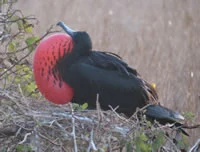
Magnificent Frigatebird

Far off the coast of Ecuador, straddling the equator, lies an archipelago of storied islands-the Galapagos. In 1835 Charles Darwin visited the Galapagos during his historic voyage on the HMS Beagle. In 1859 Darwin published his theory of natural selection based on his observations in the Galapagos more than twenty years earlier. Since then, the Galapagos Islands have attracted naturalists, scientists, writers, and the just plain curious (also known as tourists), drawn to the archipelago by its unique, diverse species.

The Galapagos Islands (literally the Islands of the Tortoises) are especially attractive to birders visiting the archipelago partly for historical reasons, but especially to view the unique diversity of birds and other creatures produced by natural selection on isolated islands as reported by Charles Darwin over a century ago.

Recently, our own Shirley Johnson presented a program entitled Galapagos-the Enchanted Isles based on her own voyage to the Galapagos. In her presentation Shirley showed photographs of the plants, animals, scenery, and, naturally, birds that inhabit the Galapagos, accompanied by lively commentary. She and her husband Bob photographed many of the fabled Galapagos birds-albatrosses, boobies, frigatebirds, penguins, and, of course, the Galapagos finches made famous by Darwin's journals. She discussed the symbiotic relationship between certain birds, like ground finches and Galapagos tortoises. These birds remove ticks and other annoying ectoparasites from the tortoise's skin with the full cooperation of the reptile. Similarly, she described the close link between the habitat of the Galapagos and the birds that live there. The nesting and feeding habits of the Cactus Finch and the prickly pear cactus, Opuntia, provided but one example. Finally, Shirley demonstrated the diversity that exists from island to island that Darwin recorded so long ago. The four species of endemic mockingbirds served as a fascinating example. Unlike the finches, Darwin had the foresight to label each of the mockingbird species he collected according to its island of residence. Later, Darwin recognized that speciation of these mockers correlated with the fact that they were able to breed in isolation, allowing their unique characteristics to emerge. 

Most of us will never visit the Galapagos Islands, except vicariously. This program reminded us of the singular importance of the Galapagos in the history of science, evolution, and conservation.

Magnificent Frigatebird photo by Bob Johnson.

Saving Bolton Valley Nordic

In February, 2011, the public learned that most of the land encompassed by the Bolton Valley Nordic Center would be sold to a private investor and that public access to the extensive trail system would be lost. In less than two months a group of community members formed the Friends of Bolton Valley Nordic and Backcountry to protect this resource and maintain public access to it. This group of over 200 concerned citizens reached out to the Vermont Land Trust, which, in February, 2012, signed a contract to purchase this 1161 acre tract for $1.85 million. A grant of $800,000 from the Vermont Housing and Conservation Board was obtained, leaving $1,050,000 to be raised from local fundraising. This fundraising campaign is in progress.

Ovenbird

Ovenbird

What's at risk? With over 90 kilometers of groomed and backcountry trails, the Bolton Valley Nordic Center is one of the three largest trail systems in Vermont. In fact, it's base elevation is the highest in Vermont. The Catamount Trail runs through the property and the trail system connects with many other routes, including those at the Trapp Family Lodge, Mount Mansfield State Forest, Underhill State Park, and Little River State Park. These trails are used throughout the year by colleges, universities, and public schools for outdoors events. Furthermore, the land and trails are heavily used by community groups as well as individuals, providing recreational access for people of all ages and ability levels. It is noteworthy that nearly half of Vermont's population lives within 30 miles of this property. The outpouring of enthusiasm for the Save Bolton Nordic project is a testimony to the widespread support for public access to this land.

Bolton Valley Nordic provides critical wildlife habitat, as well, connecting two large blocks of state land, Mount Mansfield State Park and Camel's Hump State Park. The land also includes the headwaters and much of the watershed of Joiner Brook, which feeds into the Winooski River. As a result, the Chittenden County Uplands Conservation Project has designated this property as their highest priority for conservation. 

What about the bird life at Bolton Valley Nordic? The birds inhabiting Bolton Valley have not been formally identified, though the habitat likely provides breeding territory for a variety of thrushes, vireos, flycatchers, and warblers among others. To address this issue, the Green Mountain Audubon Society, lead by Board member Liz Lee, conducted monthly bird walks on the Broadway Trail through August and created a preliminary species list for Bolton Valley Nordic. We hope that this effort will increase public awareness of the value of this land and will support the VLT fundraising campaign. For more information about the Save Bolton Valley Nordic project consult the Vermont Land Trust website at http://www.vlt.org/bolton or call 802-262-1241.

Bolton Valley Bird List

American Woodcock Brown Creeper Yellow-Warbler
Ruffed Grouse Winter Wren  Yellow-rumped Warbler 
Broad-winged Hawk Ruby-crowned Kinglet  Louisiana Waterthrush
Red-tailed Hawk American Robin  Cedar Waxwing
Mourning Dove Hermit Thrush  Scarlet Tanager 
Northern Flicker Swainson's Thrush  Indigo Bunting 
Yellow-bellied Sapsucker Wood Thrush  Northern Cardinal 
Downy Woodpecker Veery  Rose-breasted Grosbeak 
Hairy Woodpecker Red-eyed Vireo  Purple Finch 
Eastern Wood-Pewee Blue-headed Vireo  American Goldfinch 
Least Flycatcher American Redstart  Pine Siskin 
Great-crested Flycatcher Blackburnian Warbler  Chipping Sparrow 
Olive-sided Flycatcher Blackpoll Warbler  Song Sparrow 
Yellow-bellied Flycatcher Black-throated Blue Warbler   White-throated Sparrow
Eastern Phoebe Black-throated Green Warbler  Dark-eyed Junco 
American Crow Black-and-white Warbler  Red-winged Blackbird
Blue Jay Canada Warbler Common Grackle 
Common Raven Magnolia Warbler  Ruby-throated Hummingbird
Black-capped Chickadee Mourning Warbler   
Tufted Titmouse Nashville Warbler   
White-breasted Nuthatch Ovenbird    
Red-breasted Nuthatch Chestnut-sided Warbler  

Bird Habitat and Invasive Plants: A Morning at Geprags Park

markgeprag25.jpg

Geprags Park is a well-known birding spot in Hinesburg. People are drawn to the park for the variety of species that can be found there, including rarities such as Golden Winged Warblers. What is less noticed by many birders is the slow and steady progress of invasive plant species altering this important habitat.

On June 11, 2011 the Hinesburg Conservation Commission and Hinesburg Land Trust hosted a workshop at Geprags Park to highlight the importance of managing the habitat for birds and the negative impact of invasive species on critical habitat. Sharon Plumb Invasive Species Coordinator for the Vermont Nature Conservancy and Mark LaBarr from Audubon Vermont lead 27 participants into the field on a rainy Saturday morning. Mark set up mist nets and banded several birds that he caught. He explained the importance of the early successional shrubland habitat for many of the priority species that nest at Geprags. In addition to Golden-winged Warblers and Blue-winged Warblers, these include Eastern Towhees and Brown Thrashers. Mark works to protect these species and the shrubland habitat that supports them as part of Audubon’s Champlain Valley Bird Initiative. Audubon is partnering with the Hinesburg Conservation Commission,  Hinesburg Land Trust, and the Vermont Nature Conservancy to maintain the shrubland habitat at Geprags by managing against invasives and for native shrub species.

sharongeprag25.jpg

Mark’s banding demonstration was followed by a presentation by Sharon Plumb that highlighted the problems that invasive plant species pose for bird habitat. Many birders are unaware of the habitat loss that birds face due to invasive plants. Invasive plants also decrease the available food supply for birds. The buckthorn at Geprags, the predominant invasive species in the park, is an example of what can happen to bird habitat if invasive plants are not controlled.

Invasive plants outcompete native plants and in the worst case, can become a monoculture.  Many invasive plants bloom earlier and retain their leaves longer than native plants. Some are favored in landscaping because deer do not browse them. These plants then spread out from landscaped yards. Conversely, native plants tend to be overbrowsed, thus giving the invasives a larger foothold. 

For birds this altered habitat has several consequences. Many of our native plants evolved as hosts to native insect species. When invasive plants overrun an ecosystem, they disrupt an entire food chain. Native insects are less common in a habitat that is overrun by invasive plant species, having evolved with the native plants for food, egg laying and shelter.

Likewise, birds may eat the seeds and berries from invasive plants, but these plants have less nutrition than the native fruits and seeds. Unfortunately, birds also carry seeds of invasive plants to new locations.

At Geprags Park, the invasive species were mapped this past summer with the help of the Vermont Nature Conservancy and volunteers. A management plan will be written. From there, on-the-ground control of invasive plants and habitat restoration will begin.  When an infestation of an invasive plant reaches the level of the buckthorn at Geprags, complete eradication of a species is very difficult. Eliminating manyof the plants and staying on top of the infestation is often the best course of action. 

Birder’s can help stop the spread of invasive plants by looking at the landscaping on their property as well as identifying invasive plants in their fields and forests.  A small infestation is much easier to eradicate than waiting until the plant is out of control.  An excellent resource is the gallery of invaders illustrated at http://www.vtinvasives.org/, which helps to identify invasive plants and explains the best ways to eliminate them.  This website also offers native alternatives for landscaping. 

The invasive plant issue at Geprags Park illustrates the importance of not just conserving land for birds, but also keeping native ecosystems intact for nesting and feeding.

Photos of Mark LaBarr banding birds and Sharon Plumb with the workshop participants courtesy of Melissa Levy.  Thanks to Mark LaBarr for input on this article.

Restoring Endangered Species: Lessons From Puffins and Terns

twoPuffins_200.jpg

Humans have devastated seabird colonies in many parts of the world by excessive hunting for food and feathers and introducing mammals such as cats and rats to othrwise secure nesting sites.

Worldwide, 23% of all seabird species are now globally threatened as marine pollution, coastal development, and rising sea levels due to climate change take their toll. Although seabird nesting islands seem safe due to their remoteness, they are intimately connected to human activities. For example, Maine's seabird nesting islands are affected by large populations of Herring Gulls and Great Black-backed Gulls that benefit from garbage and fishing waste hundreds of miles away. As populations of these scavengers increase, they deter smaller migratory seabirds such as puffins and terns from nesting on many of their historic nesting sites. Ironically, Bald Eagles and Peregrine Falcons, the products of other successful wildlife restoration programs, now threaten rare Maine seabirds such as Great Cormorants and Roseate Terns.

Dr. Stephen Kress

Dr. Stephen Kress

Last November, Dr. Stephen Kress, the Director of the National Audubon Society's Seabird Restoration Program and the founder of Project Puffin in 1973, reviewed the techniques that he and others have developed on Maine's coastal islands that have lead to the restoration of puffins and terns on their historic nesting sites. Techniques developed in Maine have been adopted worldwide. For example, in Vermont, social attraction and the use of tern decoys, techniques developed in Maine, have been critical to the success of Audubon Vermont's Common Tern Restoration Project on Lake Champlain.

Dr. Kress entertained a large audience at the Billings Center on the UVM campus, describing the evolution of Project Puffin and the many obstacles he encountered in the process of re-introducing puffins to Maine. Despite the success of the program on East Egg Island and Seal Island, Dr. Kress emphasized that many challenges to the puffin population persist and that without human intervention these colonies would in all likelihood fail. The audience applauded his commitment to the seabird restoration program and responded enthusiastically to his plea for continued support of Project Puffin