
On Wintering Birds
By Pat Phillips, President
Along with the October fall foliage festivals and harvest markets, birders annually mark this season by observing International Migratory Bird Day. Recently, it was my good fortune to spend part of this day engaged in a Big Sit with dedicated members of the Friends of Missisquoi at the National Wildlife Refuge in Swanton. This type of event involves noting all the birds seen and heard at a given location from sunrise to sunset.
Over the course of the Missisquoi Big Sit, more than thirty species were counted, many of which were on their migratory journeys. Observing these south-bound species, I could not help but to reflect upon the incredible anatomical, physiological, and behavioral changes many of these birds undergo to carry them to wintering grounds, hundreds, thousands or even tens of thousands of miles away.
Similar to their human “snow bird” counterparts, these journeys require significant expenditures of energy, employment of navigational skills, and a measure of flexibility. The reward for this effort, for both birds and humans, includes warmer weather, copious food supplies with fresh fruit, and, for avian species, the opportunity to enjoy life without vying for territories or mates.
But what about those individuals who choose to stay? What adjustments and changes must they make to survive in cold weather with limited food resources? Warm places for shelter, insulated clothing, available food supplies, and other necessities and amenities permit humans to withstand seasonal changes in winter. Birds, however, face a greater challenge as they move into the coldest period of the year.
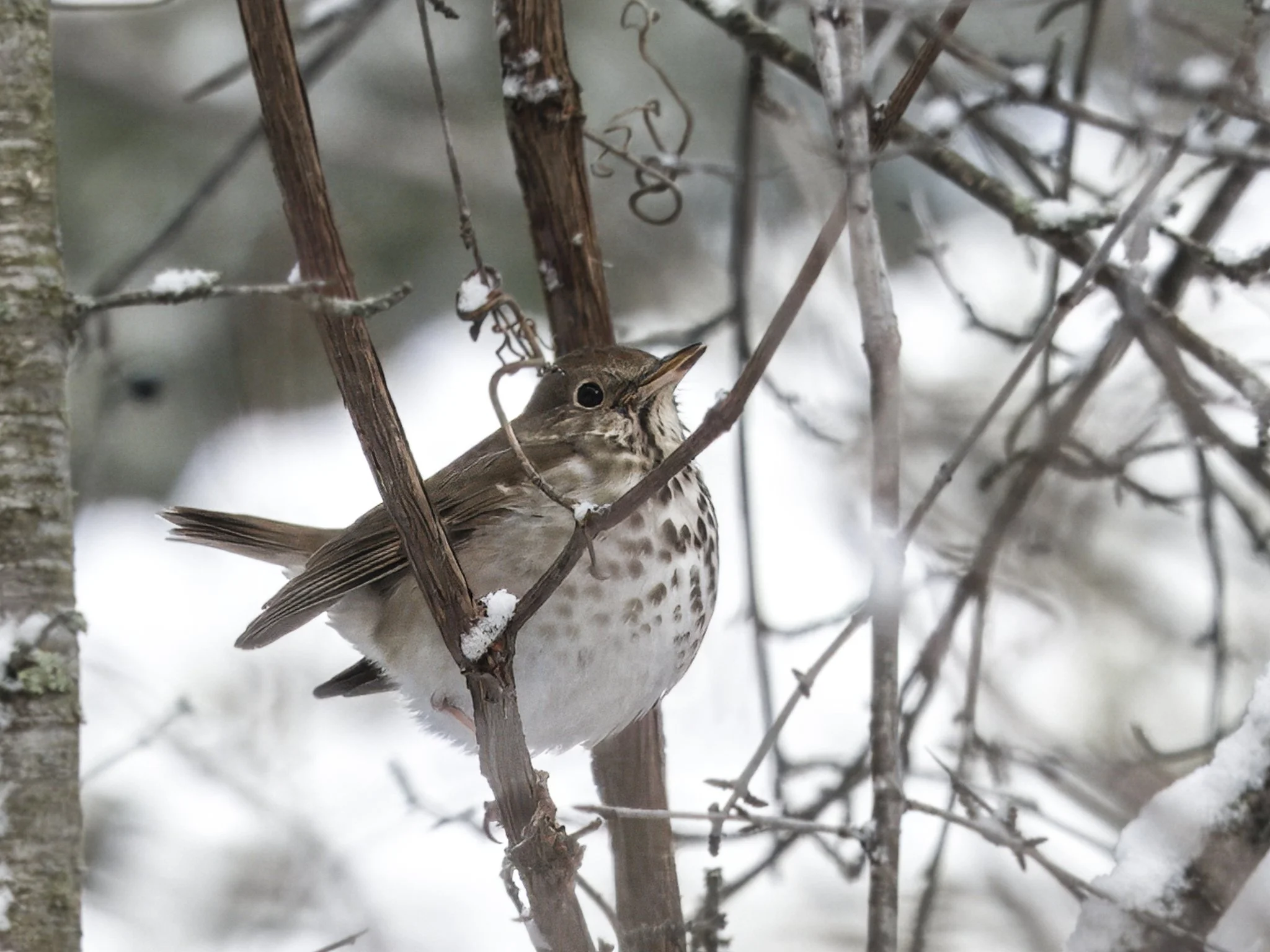
Overwintering bird species have developed some remarkable means of surviving the coldest season. Individual birds fluff out many of their contour feathers giving them a rounder, “puffy” look as they retain warm air about their bodies. These fat-looking birds can often be spotted with their bills and feet tucked into their feathery selves, high on tree branches that capture the first rays of sun on the coldest of mornings. Birds also employ shivering thermogenesis, in which their muscles quiver to produce heat, as well as non-shivering thermogenesis, in which fat is chemically metabolized in an exothermic reaction.
A number of species such as Black-capped Chickadees, Ruby and Golden-Crowned Kinglets, Tufted Titmice, and others engage in communal huddling within tree cavities or thick brush to share body heat, while Ruffed Grouse and Redpolls may be found in snow banks, insulated from the cold and hidden from predators. Some birds are able to save energy by entering a state of torpor with their body temperature slightly dropping with minimal movement. Gulls and waterfowl are able to reduce heat loss from their legs and feet, even when standing on ice. A counter-current flow of blood in which heat exchange occurs, keeps the warmest blood internally while their legs and feet, lacking in soft tissue, remain just above freezing.
To fuel their internal engines, many avians spend considerable time feeding on high-calorie nuts and seeds. Some, such as Black-capped Chickadees and Nuthatches, show increased development of the areas of the brain related to visual spatial memory. As winter approaches, this enables them to find caches of seeds that they previously stored in the summer and fall. Eastern Bluebirds and American Robins switch from an insect-rich diet to one that is primarily berries and fruits, which may be more abundant.
These cold weather adaptations are no less extraordinary than those exhibited by their migrating relatives and represent an alternative strategy that has proven successful for a wide range of species. Whether birds are year-round residents or migratory, they both face challenges presented by climate change. The increase in both the frequency and magnitude of extreme weather events is undoubtedly a threat to all birds and their habitats. In addition, changes in meteorological season length increases asynchrony between food resource availability and the emergence of fledglings.
We can all agree that birds are fascinating, beautiful, and even inspiring creatures to observe, but our appreciation of them is no longer enough. Protections for them, their habitats, and for all flora and fauna are being eroded on a daily basis. We must collectively act as their vocal advocates, supporting conservation-minded organizations and candidates concerned about the effects of climate change if future generations are to enjoy events like the Big Sit in appreciation of what we hold so dear.
© gordsheard on iNaturalist, licensed under CC-BY-NC